03.08.2026
Pfeifer CLT: Quality That Impresses Inside and Out
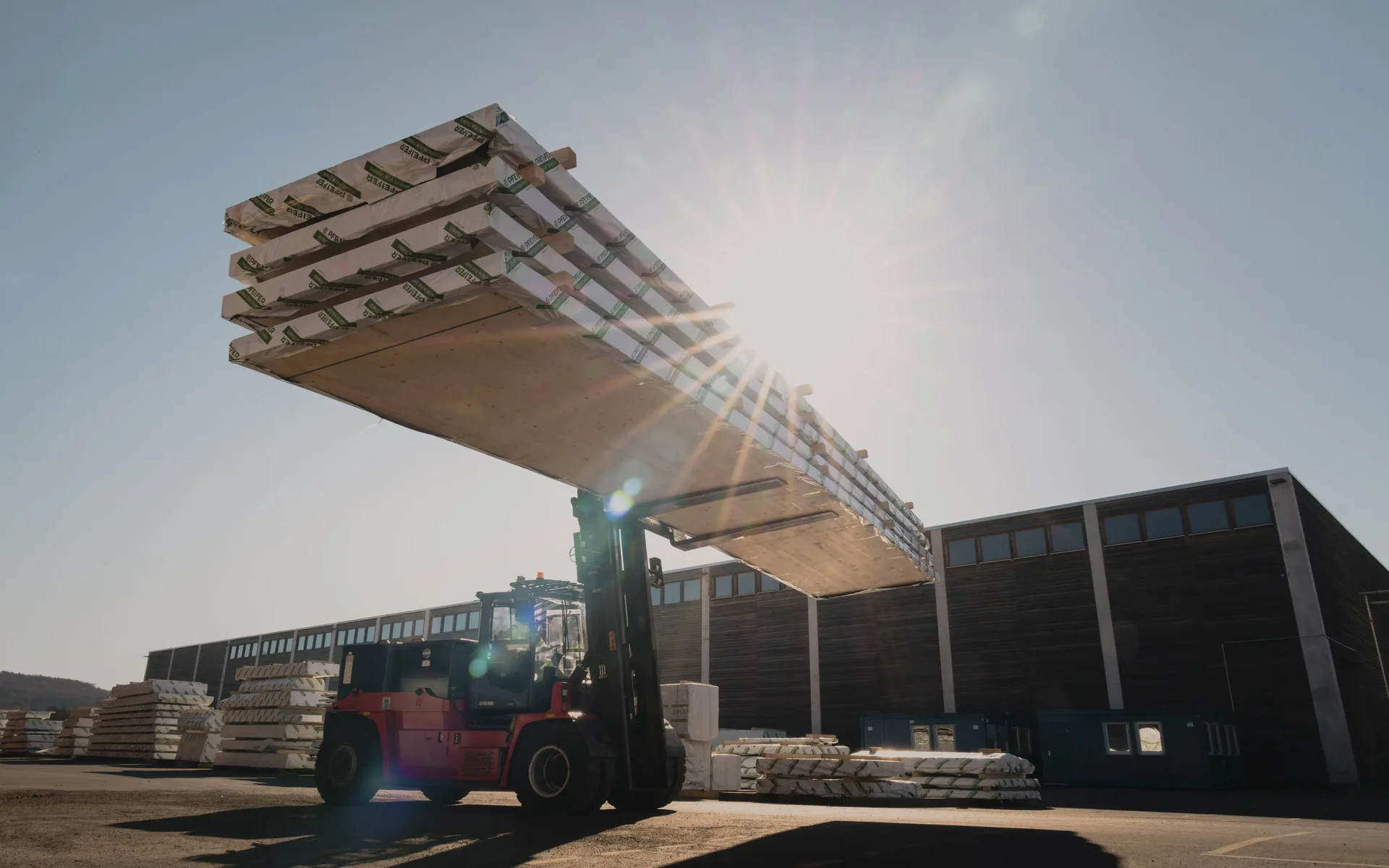
With two newly defined surface finishes for cross-laminated timber (CLT), the Pfeifer Group is responding to changing requirements in modern timber construction. The focus is on a revised appearance grade for CLT elements, designed to offer planners, timber contractors and building owners greater clarity when assessing visible timber surfaces. The CLT elements are produced at the plant in Schlitz.
Driven by the wide range of applications, short construction times and favourable living characteristics, demand for visible CLT surfaces has been rising steadily for years. To meet the diverse requirements of timber construction, Pfeifer now offers cross-laminated timber in two variants: Industrial Grade (IQ) for structural applications with subsequent cladding and Visible Grade (SQ) for visible interior applications – from residential buildings to public buildings such as schools, nurseries or administrative buildings.
A key new feature is the broader scope of the visible-grade variant, which now covers both the industrial and residential visible-grade categories. Pfeifer thus combines different market requirements into a clearly defined quality grade. Specifically, this means:
Typical Visual Characteristics of a Natural Material
The reasons behind the revision include changes in the framework conditions for raw material supply. The availability of round timber and sawn timber fluctuates more strongly than before, both regionally and seasonally; weather-related influences and changes in timber harvesting exacerbate this effect. Differences in knot patterns, colour, growth-ring structure and resin pockets cannot therefore be completely avoided, even within defined grading classes. “With the new definition of visible quality, we ensure that these characteristics are described transparently and assessed consistently,” explains Sales Manager Claus Greber. The aim is to provide planners and timber contractors with a reliable basis for tendering and assessment whilst ensuring a reliable supply.
Realistic assessment of the natural material
Last but not least, the subjective perception of surface quality was also a driver of further development. “Identifying and harmonising quality requirements is the major challenge,” says Greber. To ensure the highest possible consistency in quality on the production side, Pfeifer relies on a combination of selected raw materials, scanner technology and manual inspection. “We work with state-of-the-art technology and people who can still feel the raw material,” says Greber, describing the approach at the factory. Sampling prior to the start of a project also plays an important role.